
Quick answer
Measure the cat standing and lying down. For routine car and vet trips, start with a structured, well-ventilated carrier that opens easily and has secure zippers. Consider a backpack only if the cat already accepts confinement and the wearer can carry it comfortably. “Airline approved” and “bubble window” are features to verify, not guarantees that the carrier fits every cat or every flight.
The carrier is one of the few pieces of pet hardware that affects the whole trip before the destination. A bag that collapses inward, opens awkwardly, or leaves little room to turn can turn a short appointment into a struggle. Fit is the first filter; style is secondary.
Measure before comparing features
- Length: from the chest to the rear while the cat stands naturally.
- Height: from floor to the top of the head while standing, with enough additional room to turn.
- Weight: use the current weight and leave a comfort margin below the listed maximum.
- Carrying distance: consider your height, shoulder comfort, and whether you must also carry keys, a phone, or a second bag.
Test the empty carrier at home. The cat should be able to stand, turn, and lie down. If the carrier is soft-sided, check that it does not fold inward when the cat leans against the side.
Match the format to the trip
| Trip | Useful format | What matters most |
|---|---|---|
| Routine vet visits | Structured soft carrier or rigid carrier | Wide opening, stable floor, easy cleaning, privacy cover |
| Car travel with the cat beside you | Soft carrier with secure zippers and a firm base | Anchoring or seat placement, ventilation, and a non-collapsing body |
| Short walks or hiking stops | Backpack with structured frame | Wearer comfort, ventilation, load balance, and a secure interior |
| Air travel | Carrier selected to the airline's current cabin rules | Exact dimensions, soft-side compressibility, and the pet staying with you |
Soft carrier, hard carrier, or backpack?
Soft carrier
The FUKUMARU carrier combines mesh panels with a rollable cover, making it useful when a cat needs more visual privacy in a lobby or car. The soft body is easy to store, but it offers less protection than a rigid crate. Check the zippers and internal frame before each trip.
Read the FUKUMARU carrier review →
Backpack
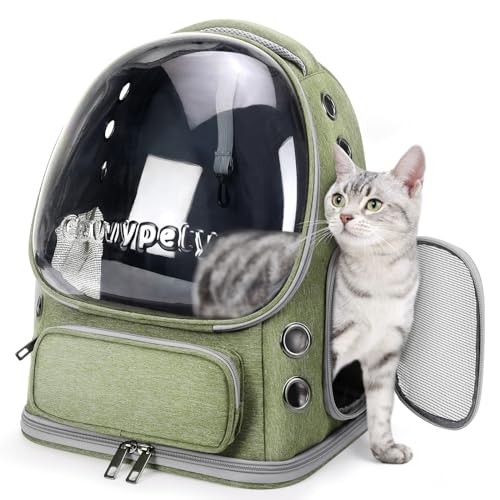
A backpack is convenient for hands-free walking, but it is not automatically better for the cat. A bubble window can create a clear view or too much exposure, depending on temperament. The bag should keep its shape when the cat shifts and should distribute weight evenly across the wearer's back.
Compare the standard Cawypety backpack → or the expandable model →.
Rigid carrier
A hard-sided carrier is the more protective default when the cat settles comfortably inside and the carrier can be stored without taking over the room. The tradeoff is bulk, especially in small cars. Check the door action and whether the top can be removed in a veterinary setting.
The carrier fit checklist
- The cat can stand without crouching and turn without folding its body.
- The floor insert is firm and does not slide when the cat shifts.
- At least two sides provide airflow, and no mesh panel pushes inward.
- Zippers and buckles stay closed; a secondary clip is useful on a backpack.
- The opening is large enough to lower the cat inside without forcing a leg or tail.
- The carrier fits the vehicle seat or cabin space you will actually use.
- For air travel, the airline's current rules match the measured carrier, not just the marketing label.
Make the carrier familiar before travel day
Leave the carrier open in the room with a familiar blanket inside. Reward voluntary investigation and allow the cat to leave. Do not turn the carrier into a trap by only bringing it out before a vet visit or by forcing the cat inside after a struggle.
Once the cat enters comfortably, close the flap briefly, then reopen it. Build toward lifting and carrying the empty-weight bag before adding motion. If the cat becomes distressed, stop and make the step easier.
Buy now or wait?
| Buy now | Wait |
|---|---|
| A carrier that fits the measured cat and your usual vehicle | A backpack before testing whether the cat accepts enclosed carrying |
| A washable pad and familiar blanket | Several sizes in case one works |
| A simple privacy cover or carrier with a rollable panel | A bubble design solely because it looks more visible |
| A carrier that can be secured for the chosen mode of travel | A soft bag marketed as airline-approved without checking dimensions |
Research sources
- Traveling with pets — American Veterinary Medical Association
- Car safety — ASPCA
- Current manufacturer dimensions, loading instructions, weight limits, and recurring verified-buyer feedback.

Independent, source-based research for U.S. cat and dog owners. Product fit cannot be confirmed by photos alone; measure the animal and transport space.