
Quick answer
Measure the dog and the vehicle before buying. Choose one system—a booster seat, structured crate, or harness-and-tether setup—and confirm that every strap reaches its intended attachment without forcing the seat or compressing the dog. Practice while parked, then take short low-speed trips. A tether is not a complete crash-protection system, and “car seat” does not automatically mean “crash-tested.”
The most common mistake is buying more equipment than the car can actually accommodate. A booster that blocks the center console, a crate that does not allow the dog to stand and turn, or a tether so long that the dog can reach the driver creates a new problem. The first week should be about fit, familiarity, and calm repetition.
Before buying: measure three things
- The dog: measure standing height, body length from chest to rear, and current weight. Use the manufacturer's limit as a ceiling, not a target.
- The vehicle seat: measure width, depth, and available height beneath the ceiling. Check whether the seat folds, slides, or contains an armrest or console.
- The attachment: identify the seat-belt receiver, LATCH points, headrest posts, and cargo anchors allowed by the vehicle manual. Do not assume every car or rear-seat layout is compatible.
No tether, booster bed, or soft-sided carrier should be presented as universal crash protection unless the maker provides relevant independent testing for that specific use. Follow the vehicle and product instructions together.
A practical first-week sequence
These are stages, not deadlines. Repeat a stage if the dog is worried, the car is new, or the equipment needs adjustment.
| Stage | Practice | What to check |
|---|---|---|
| Days 1–2 | Leave the seat or crate in a familiar room. Let the dog inspect it without closing a door or attaching a tether. | Can the dog stand, turn, lie down, and enter without ducking? |
| Day 3 | Move the equipment into the parked car. Reward calm investigation with the engine off. | Does it block the door, seat belt, or another passenger? |
| Day 4 | Attach the product with the car parked. Check every strap twice and leave the dog briefly while you stand nearby. | Can any strap loosen, slide off a headrest, or reach the controls? |
| Day 5 | Start the engine without moving. Add a passenger if that is part of the normal routine. | Does noise or vibration change the dog's ability to settle? |
| Day 6 | Take one short, low-speed trip. Return before the dog becomes restless. | Record loading time, posture, panting, and whether the equipment shifted. |
| Day 7 | Repeat the easiest successful trip. Change only one variable—route, passenger, or destination. | Keep what worked; simplify anything that required force or constant correction. |
Choose the smallest system that solves the problem
Booster seat
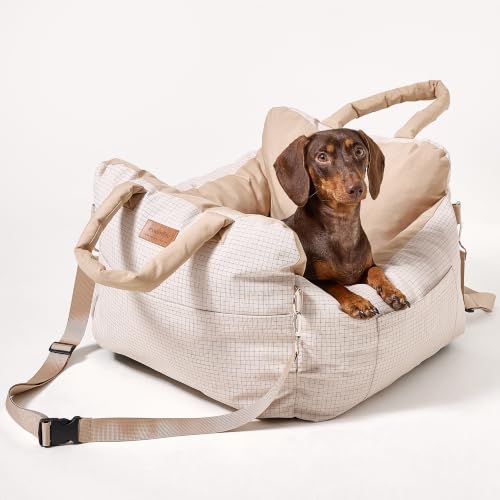
A booster can give a small dog a stable, familiar place to settle and a clearer view. It makes the most sense when the dog is within the stated weight range and the seat shape fits the vehicle without interfering with the seat belt.
Compare the WOOCHPET booster seat → or see the softer FUKUMARU car seat →.
Structured car crate
A crate is the better question when the dog needs more physical definition, a flatter floor, and mesh on several sides. It also takes more space. Confirm that it can be secured without blocking the seat belt or crushing the seat cushion.
Read our Snagle Paw car-crate review →.
Harness and tether
A tether is compact and useful for limiting movement, but its performance depends on the attachment point and a correctly fitted harness. The tether should connect to the harness rather than a collar and should leave enough length to sit or lie down without reaching the front seat.
Buy now, or wait?
| Buy after checking | Wait when |
|---|---|
| A harness that already fits the dog | You have not measured the dog or vehicle |
| One booster or crate with verified dimensions | The product would block a door, seat belt, or passenger |
| A tether with the correct attachment type | You expect a tether alone to guarantee crash protection |
| A washable liner or mat that fits the chosen seat | You are buying several accessories before testing the main product |
The five-minute fit check before every trip
- Clip, buckle, or route every strap exactly as instructed; tug gently to confirm it is seated.
- Check that the dog can stand without hitting the ceiling and turn without folding its body.
- Keep window controls, the gear selector, pedals, and airbag zones clear.
- Inspect seams, mesh, buckles, and attachment loops for wear.
- Carry a backup leash and a towel; do not improvise a restraint from a collar alone.
Research sources
- Traveling with pets — American Veterinary Medical Association
- Car safety — ASPCA
- Current manufacturer dimensions, weight limits, attachment instructions, and owner-feedback themes in Amazon listings.

Independent, source-based research for U.S. cat and dog owners. This guide is not veterinary advice and does not certify any product as crash protection.