
Quick answer
For a cat that carries litter more than a couple of steps, start with a waterproof mat at least 35 × 23 inches and place the long side across the observed exit path. If the cat jumps, turns, or shares a busy box, a 47 × 36-inch mat is the more realistic starting point.
What matters most
- Measure the landing zone, not just the litter box.
- A large flat mat usually beats several disconnected small pads.
- Waterproof construction matters more than decorative texture.
- No mat replaces cleaning the floor around the box.
Why litter reaches the rest of the room
Litter travels because it sticks to paws, gets kicked over the rim, or falls from the cat's coat as it leaves the box. A textured mat gives those pieces somewhere to collect before the cat reaches carpet or a hallway. The mistake is buying a small “door mat” and expecting it to cover a landing strip created by a cat that exits at speed.
Watch one normal visit before buying. Note whether the cat jumps forward, turns immediately, or walks several steps. That route determines the useful mat area more reliably than the dimensions printed on a product page.
Pick the size from the landing path
For a standard single-cat bathroom, a mid-size mat around 35 × 23 inches is a practical starting point. It gives the cat more than one step to shed litter without covering the entire floor. For an extra-large box, a multi-cat home, or a cat that leaves the box quickly, move up to a mat around 47 × 36 inches.
A small mat around 20 × 28 inches can still work in an apartment or at a second box, but it should be treated as a targeted barrier. If litter regularly reaches beyond its edges, adding more small mats usually creates a cleaning problem rather than solving one.
| Situation | Useful mat size | Why |
|---|---|---|
| Quiet single cat, compact box | Compact to mid-size | Enough coverage for a short exit path. |
| Standard bathroom or laundry room | Around 35 × 23 in | Balanced coverage and cleaning effort. |
| Fast exit, large box, or multiple cats | Around 47 × 36 in | More room for paws and several steps. |
What surface actually helps
A useful litter mat needs a surface that disturbs the paw enough to release litter, a backing that does not slide, and an edge that will not become a trip hazard. Waterproof material makes the mat easier to rinse and prevents wet litter from soaking into a fabric border.
Complex channels and deep pockets collect more debris, which is good only if you will shake or vacuum them consistently. A simpler textured surface can be the better choice for a household that needs a mat to be lifted and cleaned in seconds.
- Textured waterproof mat: simplest to shake, vacuum, and rinse.
- Two-layer trapping mat: potentially more capacity, but more places for fine litter to collect.
- Fabric or fluffy mat: not ideal for litter because it can hold dust and moisture.
Placement beats added accessories
Put the mat where the cat lands, not just where the box opening points. If the box faces a wall and the cat turns sideways, rotate the mat. If the cat jumps over a narrow strip, extend the coverage farther forward. Leave the mat flat and make sure a lid, door, or furniture does not force the cat to step around it.
Keep one simple cleaning routine: shake or vacuum frequently, rinse when residue appears, and dry the mat fully before putting it back. A mat that stays damp or dirty is not an upgrade to the room.
Four mistakes that keep mats ineffective
- Buying for the box instead of the cat: a mat under the front edge can miss a side exit or jump entirely.
- Using several disconnected pieces: gaps create places for litter to fall through and make cleanup slower.
- Ignoring movement: a mat that slides or bunches can make the cat avoid it.
- Cleaning only the middle: fine litter gathers at edges and under the lip, where it can be carried back onto the floor.
The fix is usually one correctly sized mat in the right location, cleaned consistently. If tracking continues after that, observe whether the litter itself is very fine, the box is too small, or the cat exits from a second side that the mat does not cover.
Our product picks for this job
Prices below are refreshed from the Amazon product feed when the page loads. Confirm the selected size, color, seller, and final price on the listing. Shopping links may earn PawGearVerified a commission at no extra cost to you.
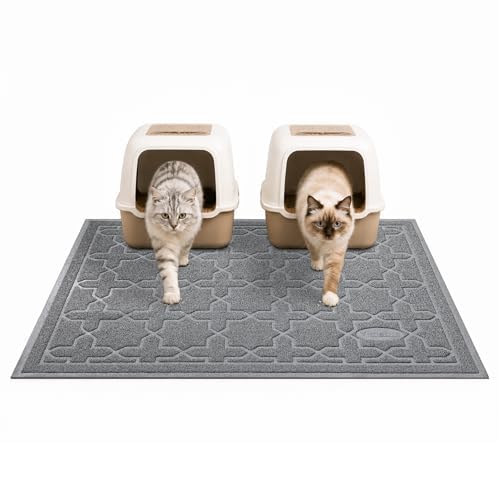
Yimobra Waterproof Litter Mat, 47 × 36 in
The extra-large waterproof surface is the most convincing choice when one small pad has not stopped litter from spreading across the room.
Amazon listed price
$29.99
At last check October 23, 2026
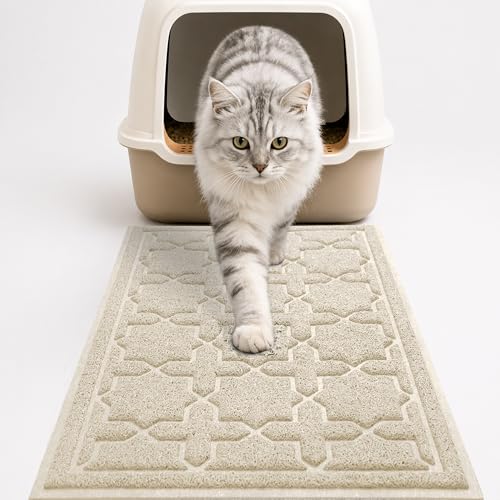
Yimobra Waterproof Litter Mat, 35.4 × 23.6 in
A practical middle size for a standard single-cat bathroom, with enough coverage for several steps without taking over a small room.
Amazon listed price
$19.99
At last check October 23, 2026
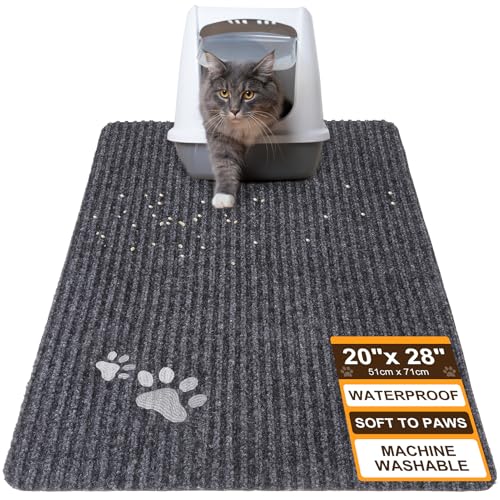
BEAUTYZOO Waterproof Litter Mat, 20 × 28 in
A low-cost targeted mat for a small bathroom or a second box. Choose it when litter stays near the immediate exit.
Amazon listed price
$13.49
$14.24
At last check October 23, 2026
Common questions
Do larger litter mats really reduce tracking?
They can reduce how far litter travels because the cat takes more steps on a textured surface before reaching the floor. A mat still has to be placed on the actual exit route and cleaned regularly.
Should I put a mat under the whole litter box?
It is usually more useful to cover the landing and exit path. A small lip under the box can protect the floor, but the largest area should extend where the cat actually steps.
How often should a litter mat be cleaned?
Shake or vacuum it as often as litter accumulates, then rinse it when residue or odor appears. Follow the manufacturer's care instructions and dry it fully.
Research sources
We combine manufacturer specifications and instructions with established pet-care guidance and recurring themes in public owner feedback. We do not claim hands-on testing for every unit.
- Litter box problems — ASPCA
- Feline litter-box guidance — Cornell Feline Health Center

Practical pet-hardware research for U.S. cat and dog owners. Product fit and safety depend on the individual pet, home, and current manufacturer instructions.